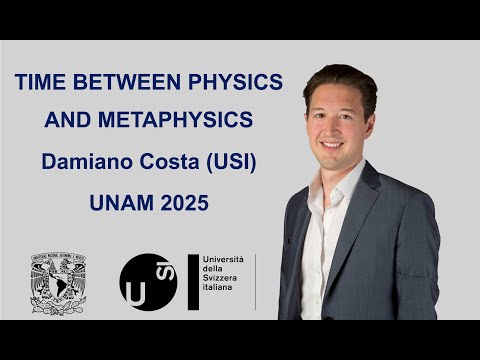
Curso - Time Between Physics and Metaphysics

Instituto de Investigaciones Filosóficas
Facultad de Filosofía y Letras
Posgrado en Filosofía
Proyecto PAPIIT IN405323 y Programa PAECI
Time is one of the most intriguing and puzzling aspects of reality. It is also one of the most hotly debated topics throughout the history of philosophy. This seminar, designed for graduate students, introduces some of the central contemporary philosophical perspectives on this perplexing subject. The approach of this course brings together two perspectives: considerations from a priori metaphysics will be mixed with insights from the metaphysics of physics, with particular attention to relativity theory. While prior familiarity with analytic metaphysics will be helpful, no background in physics is necessary (for the elements of relativity needed for the course will be introduced).
Though no pre-reading is required, it may be helpful to look over the following beforehand:
Gilmore, Cody; Costa, Damiano & Calosi, Claudio (2016). Relativity and Three Four‐
dimensionalisms. Philosophy Compass 11 (2):102-120.
Further more specific readings are suggested (but neither necessary nor expected) for each lecture.
LECTURE 1. SPACETIME
October 28, 2025
In both scientific and popular discourse, we often hear about spacetime. Yet the very idea of spacetime is relatively new in the history of human thought. What exactly is spacetime? Is it something distinct from space and time? And why should we believe it exists? In this first session, we will examine the debate between spatiotemporal unitism and separatism, as well as the competing views of substantivalism, supersubstantivalism, and relationism about regions.
Selection of readings:
Dainton, Barry Francis (2010). Time and Space: Second Edition. Acumen Publishing.
Dasgupta, Shamik (2015). Substantivalism vs Relationalism About Space in Classical Physics. Philosophy Compass 10 (9):601-624.
Horwich, Paul (1978). On the existence of time, space and space-time. Noûs 12 (4):397-419.
LECTURE 2. THE PRESENT AND BEYOND
October 30, 2025
We remember and regret the past, we fear or hope for the future; yet we seem to live only in the present. Or do we? What is the present? Is it truly a razor-thin boundary of being between two vast abysses of nothingness? In this second session, we will address the debate between presentism and eternalism, together with the questions of the passage of time and reality of tense. Our focus will be on mapping the range of possible theories, as well as evaluating arguments from both a priori metaphysics and the metaphysics of relativity for and against them.
Selection of readings:
Skow, Bradford (2015). Objective Becoming. Oxford: Oxford University Press UK.
Fine, Kit (2006). The Reality of Tense. Synthese 150 (3):399-414.
Sider, Ted (2001). Four Dimensionalism. Oxford University Press UK.
Wüthrich, Christian (2013). The fate of presentism in modern physics. In Roberto Ciuni, Giuliano Torrengo & Kristie Miller, New Papers on the Present: Focus on Presentism. Philosophia Verlag. pp. 91–111.
LECTURE 3. FOUR-DIMENSIONALISM
November 3, 2025
Who are we? Some philosophers believe that contemporary physics and metaphysics suggests one, albeit admittedly partial, answer to this age-old question: we are four-dimensional entities inhabiting an eternal spacetime. But what does it mean to be four-dimensional? Why should we think of ourselves this way? And what are the implications for our survival, persistence, and moral responsibility? In this final session, we will survey contemporary theories of persistence and their motivations, before turning to some now-classical considerations concerning our diachronic personal identity.
Selection of readings:
Costa, Damiano (2020). Persistence in Time. Internet Encyclopedia of Philosophy.
Gilmore, Cody (2006). Where in the relativistic world are we? Philosophical Perspectives 20 (1):199–236.
Parfit, Derek (1984). Reasons and Persons. Oxford, GB: Oxford University Press, section III.
Olson, Eric T. (2024). Personal identity. In E. N. Zalta & U. Nodelman (eds.), Stanford Encyclopedia of Philosophy.
16:00-18:00 horas
Martes 28 de octubre, Aula Luis Villoro
Jueves 30 de octubre, Sala Fernando Salmerón
Lunes 3 de noviembre, Aula Luis Villoro
Instituto de Investigaciones Filosóficas, UNAM
Se otorgará constancia de asistencia. El curso se impartirá en inglés y no habrá traducción simultánea.
Informes: Dr. Edgar Gonzalez Varela joedgova@googlemail.com


 Ago 25 de 2026
 Aviso de privacidad
 Circuito Maestro Mario de la Cueva s/n, Ciudad Universitaria, C.P. 04510, Coyoacán México, CDMX